
Why shower glass clouds up faster in Durham Region
The water coming out of your shower head in Oshawa, Whitby, Ajax, or Pickering carries about 125 mg/L of dissolved calcium carbonate. That number lands right at the line between moderately hard and hard on the scale most water agencies use, and every drop that dries on glass leaves its minerals behind. Knowing how to clean shower glass doors starts with accepting that this film is going to come back, so the goal is to remove it while it is still soft.
I have looked at a lot of shower doors in this region, and the ones that look permanently frosted almost never got there from one bad month. They got there from years of the same pattern: water dries, minerals stack, soap binds to the minerals, and the owner scrubs harder each time with something that should never have touched glass. The good news is that the fix is mostly chemistry and timing, not effort.
Is it hard water film or soap scum?
Hard water film is chalky, white, and dry to the touch, while soap scum is slightly waxy and greasy. Most shower doors in this area have both, layered on top of each other, and they need different cleaners.
| Sign | Hard water film | Soap scum |
|---|---|---|
| Texture | Rough, chalky | Slightly greasy or waxy |
| Colour | White or grey spots | Cloudy grey or yellowish haze |
| Where it collects | Everywhere water dries | Lower half, near the bar soap |
| Reaction to a drop of vinegar | Fizzes faintly, softens | No reaction |
| What removes it | Mild acid | Warm water and dish soap |
The vinegar test in that table is the one I trust most: put a drop on a bad spot and watch it for ten seconds. If the spot softens or you see tiny bubbles, it is mineral scale and an acid will handle it. If nothing happens, you are looking at soap residue, and the acid will just slide off it.
Which acids are safe for shower glass?
Any mild acid is safe on tempered shower glass, as long as it is rinsed off afterward and kept away from natural stone. The three I reach for are white vinegar, citric acid, and a commercial descaler labelled for glass.
| Cleaner | Safe on glass | Keep it off | Notes |
|---|---|---|---|
| White vinegar (5 percent) | Yes | Marble, travertine, unsealed grout | Cheap, slow, needs a few minutes of contact |
| Citric acid (2 to 3 tablespoons per litre) | Yes | Natural stone | Less smell than vinegar, works a little faster |
| Glass-safe descaler (sulfamic or citric) | Yes | Follow the label for metals and stone | Fastest of the three, read the dwell time on the bottle |
| Hydrofluoric-based or “restoration” acids | No | Everything in a home bathroom | These etch glass and burn skin; leave them to the trades |
| Abrasive powders, steel wool, scouring pads | No | All glass | Scratch the surface and give minerals more to grip |
Vinegar is my default because it is nearly impossible to overdo. Citric acid is what I suggest for people who hate the smell. The descalers under the sink at a hardware store are fine, provided the label says glass and you do not let them dry on a metal frame.
One caution that bears repeating: acids and natural stone do not mix. If your shower has a marble curb, a travertine bench, or a stone tile floor, protect it with a towel or plastic before you spray the glass, and rinse any runoff right away.
How to clean shower glass doors, step by step
Clear the soap scum first, then attack the minerals, then dry the glass. Doing it in that order is the difference between one pass and three.
- Run the shower hot for a minute. Warm glass loosens soap film and helps the acid work faster.
- Wash the glass with a few drops of dish soap on a damp microfibre cloth. Rinse. This removes the greasy layer so the acid can reach the scale.
- Spray undiluted white vinegar (or your citric solution) on the glass from the top down. Keep it wet for five to ten minutes. Re-spray if it starts to dry.
- Wipe with a non-scratch white pad or a microfibre cloth, using light pressure. Let the acid do the lifting.
- Rinse thoroughly with clean water, including the frame, hinges, and any metal trim.
- Dry the glass with a squeegee, then a dry microfibre cloth. Wet glass is where the next round of spots starts.
For a door that has not been cleaned in months, expect to repeat steps three and four twice. What you should not do is switch to something stronger after one attempt. If two rounds of acid and a full soapy wash leave a haze behind, the problem is no longer on the surface.
What actually etches glass
Glass is etched by minerals left in place long enough to react with the silica in the glass, and by the wrong tools used to remove them. Cleaners get the blame far more often than they deserve.
- Time. Fresh deposits sit on top of the glass and come off with acid. Deposits left for years react with the glass itself and leave microscopic pits. At that stage the glass feels rough and dry, and it is permanent.
- Razor blades. Tempered glass can carry tiny fused particles from manufacturing, and a blade drags them across the surface. Every professional window cleaner I know refuses to scrape tempered glass for this reason.
- Abrasive powders and green scouring pads. They leave fine scratches that trap more minerals, so the door looks worse faster.
- Harsh acids and caustic drain-style cleaners. Strong enough to dull the surface, and dangerous to breathe in a small room.
Etched glass cannot be cleaned back to clear. The honest options are professional polishing (which is not always successful), replacing the panel, or living with it and keeping it dry so it looks its best.
The squeegee habit that does most of the work
Twenty seconds with a squeegee after every shower prevents more buildup than any cleaner removes. Minerals only deposit when water dries in place, so glass that is wiped down never gets the chance to spot.
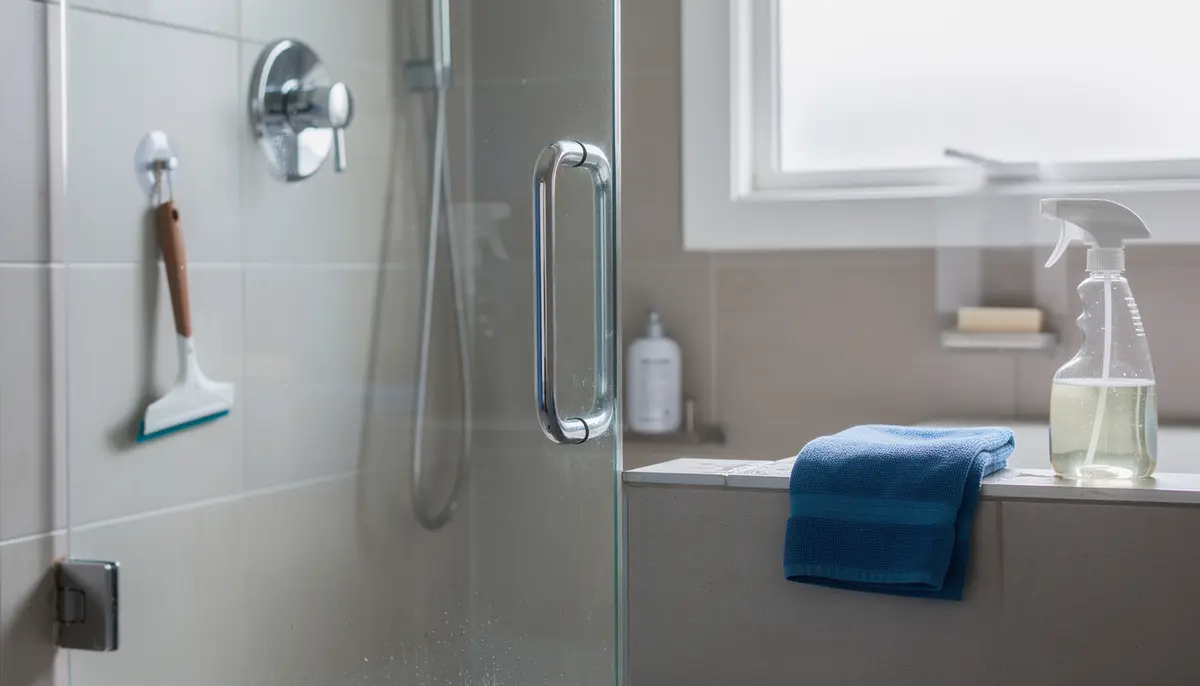
Keep the squeegee hanging inside the shower, not in a drawer across the room. Pull top to bottom in overlapping strokes, then run the blade along the bottom edge where water pools. Most guides on how to clean shower glass doors treat this as an afterthought, and it is the whole game.
Once a week, follow up with a quick vinegar spray and wipe, which takes about three minutes on a standard door. That weekly wipe is the same reason our cleaners squeegee the glass at the end of every visit rather than leaving it wet.
Switching from bar soap to a liquid body wash also helps more than most people expect. Bar soap contains the fats that bind minerals into the waxy scum layer. Liquid washes leave far less behind.
When the bathroom needs more than a wipe
If the shower glass is only one of several things that have drifted, a bathroom-by-bathroom reset is faster than fixing them one at a time. A deep cleaning visit descales the glass, tile, and fixtures together, and scrubs the grout lines that a daily squeegee never reaches. Our printable deep cleaning checklist lays out the full bathroom scope if you would rather work through it yourself.
Tonight, after your shower, hang a squeegee on the inside of the door and use it once. Do that for a week and the difference on the glass will tell you everything you need to know about the habit.