
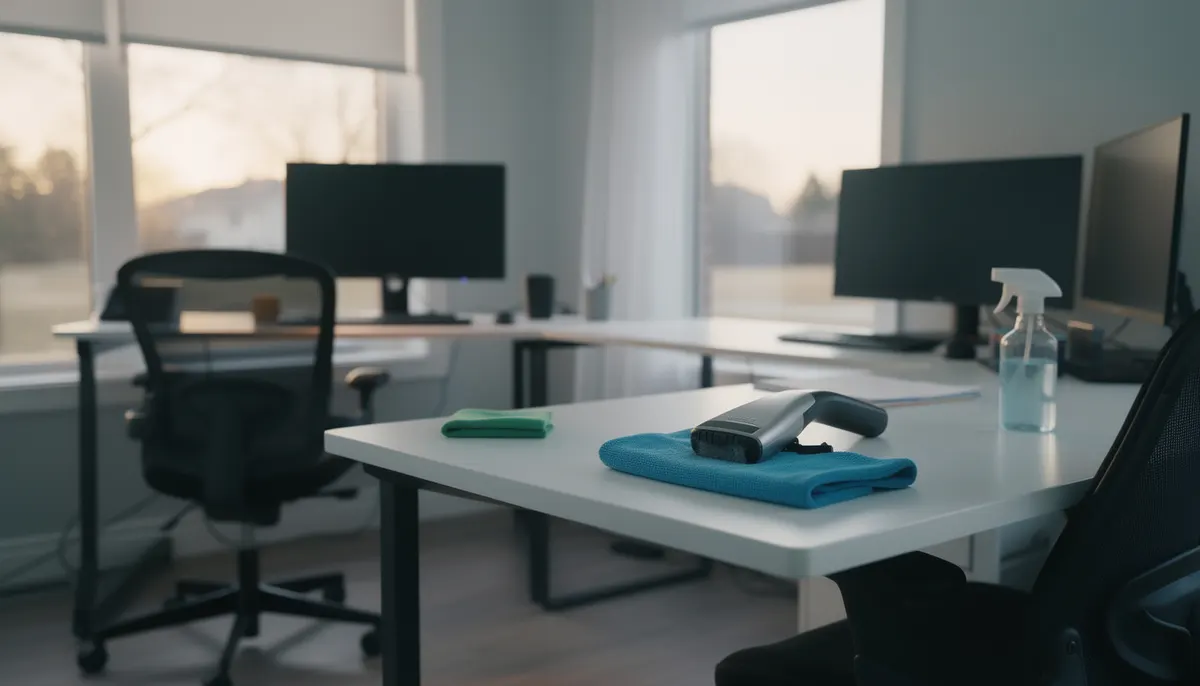
An office cleaning checklist only works when every task carries a frequency and a name. Most of the checklists we see taped inside supply closets in Oshawa and Whitby offices are a wall of tasks with no tiers, so the washrooms get done and the vents never do. Four tiers (daily, weekly, monthly, quarterly) fix that, because the tier tells you who does the work and when you should notice if it slipped.
Why tiers matter more than the task list
The tier is the decision. A task assigned to “daily” goes to whoever is in the building every night, usually your cleaning service. A task assigned to “quarterly” needs a calendar reminder and, often, a separate quote, because it is not part of a routine visit.
Without tiers, three things happen. Visible tasks get overdone (someone wipes the reception desk twice a day) while invisible ones (the top of the fridge, the underside of the kitchen table) go untouched for a year. Staff start doing their own cleaning, which is the clearest sign your schedule is broken, and when you change providers nobody can say what the old one was actually doing.
What belongs on the daily office cleaning checklist?
Daily means every night the office was used. It covers anything that touches hands, food, or plumbing, plus floors along the paths people actually walk.
| Zone | Daily tasks |
|---|---|
| Washrooms | Clean and disinfect toilets, urinals, sinks, taps, flush handles, and stall latches. Restock paper, soap, and sanitizer. Empty bins. Mop the floor. |
| Kitchen and break room | Wipe counters, table, sink, and appliance handles. Empty bins and recycling, replace liners. Spot-mop spills. |
| High-touch points | Door handles, push plates, light switches, elevator buttons, printer and photocopier panels, shared keyboards, kettle and coffee machine handles. |
| Reception and meeting rooms | Wipe desk and tables, straighten chairs, clear cups, spot-clean glass doors at hand height. |
| Floors | Vacuum main corridors, entrance mats, and open workstation areas. Mop hard floors in the entrance, kitchen, and washrooms. |
| Bins | Empty every bin, including under desks, and replace liners where soiled. |
The high-touch line is the one most offices skip. CCOHS lists light switches, door handles, counters, chairs, railings, and payment devices as the surfaces that need more frequent attention than everything else, and none of those show dirt.
Nightly cleaning fits offices with 10 or more people, or any office that receives clients. If yours is smaller, the daily tier can run two or three nights a week; the office cleaning frequency guide walks through how to size that by headcount and traffic.
Weekly tasks: the difference between tidy and clean
Weekly is where dust gets removed instead of moved. Daily visits keep the office presentable; the weekly pass reaches the surfaces people see but do not touch.
- Dust every horizontal surface, including desks (around monitors and keyboards, not under a stack of paper), shelves, windowsills, and the tops of filing cabinets
- Vacuum every carpeted area edge to edge, including under desks and behind doors, and move chairs to do it
- Mop all hard floors, not just the entrance and kitchen
- Clean interior glass partitions, meeting room glass, and entrance doors fully, not just the smudge at hand height
- Wipe the front of the fridge, the microwave inside and out, and the dishwasher door
- Sanitize desk phones and shared headsets
- Wipe washroom walls and partitions, clean mirrors edge to edge, and pour water down floor drains so the traps do not dry out
- Scrub the inside of the kitchen sink and descale the kettle, which builds scale quickly on Durham Region’s Lake Ontario water
Pick one night for the weekly pass and tell staff which one. A desk buried in paper cannot be dusted, and a cleaner who moves your paperwork is a bigger problem than dust.
Monthly tasks nobody assigns
Monthly tasks are the ones you notice only when a visitor points them out. Assign them to a specific visit (the first Thursday, say) so they are never “next week.”
- Wipe HVAC vent covers and return grilles, which pull lint and dust toward the ceiling all month
- Dust blinds, the tops of door frames, picture frames, and light fixtures reachable from the floor
- Vacuum upholstered chairs in reception and meeting rooms, including the crease where the seat meets the back
- Clean out the fridge: everything unlabelled goes, shelves come out and get washed
- Wipe baseboards along corridors and under desks
- Wash washroom bins and kitchen bins inside and out, not just re-line them
- Wipe the walls around light switches, the kitchen backsplash, and the wall behind the bins
- Clean the interior side of exterior windows you can reach from the floor
That last item is interior, reachable glass only. Exterior and upper-floor glass is a separate trade and should not be on this list.
What goes on the quarterly office cleaning checklist?
Quarterly tasks protect the building, not just its appearance. Several are outside a standard cleaning visit and need their own quote or a specialist trade, so put them on the calendar in January, April, July, and October.
| Quarterly task | Who typically does it | Why it is quarterly |
|---|---|---|
| Strip, scrub, or refinish hard floors | Floor care specialist | Winter salt and grit dull the finish; spring is the usual reset |
| Carpet extraction | Carpet cleaning specialist | Vacuuming lifts surface dirt; embedded grit needs extraction |
| Deep kitchen: inside cabinets, under appliances, behind the fridge | Cleaning service (deep clean visit) | Crumbs and grease collect where the daily wipe never reaches |
| High dusting: ceiling corners, exposed ductwork, tops of tall cabinets | Cleaning service with the right ladder | Cobwebs and dust bloom show up within three months |
| Wipe every chair frame, arm, and keyboard tray | Cleaning service | Hand oils build up on surfaces people lean on |
| Review supply levels and dispenser condition | Office manager | Broken dispensers get worked around instead of reported |
Carpet extraction and floor refinishing are not something we do, so book those trades separately. What a commercial cleaning service should cover is the quarterly deep pass on the kitchen, the high dusting, and the chairs, priced as its own visit rather than squeezed into a Tuesday night.
Who does what: staff versus the cleaning service
Your staff own their desks and their dishes. Everything shared belongs to the cleaning service. Draw that line in writing and the arguments stop.
| Task | Staff | Cleaning service |
|---|---|---|
| Clear personal desk surface so it can be dusted | Yes | |
| Own dishes into the dishwasher by end of day | Yes | |
| Wipe the shared kitchen counter after a spill | Yes (at the moment) | Yes (every visit) |
| Empty desk bins | Yes | |
| Restock washroom paper and soap | Yes | |
| Report a broken dispenser or dripping tap | Yes | Yes |
| Label food in the fridge with a date | Yes | |
| Fridge cleanout | Yes (monthly) |
If your weekly dusting lands on Thursday night, ask for a clear-desk Thursday. Staff comply with a rule that has a day attached far more readily than with a rule that says “keep your desk tidy.”
How do you hold your cleaning company to this checklist?
Put the tiered checklist in the scope of work and ask for it back signed. A provider that gives you a written scope, an assigned team, and a monthly check-in is the baseline described in our guide to what a commercial cleaning service should deliver; the tiered checklist is the document you bring to that conversation.
Then audit it yourself, once a month, in ten minutes. Pick three daily tasks, two weekly, and one monthly, and check them on a random morning. If the vent covers are furry in week six, the monthly tier is not happening, and you will know before a client does.
Missed items reported within 24 hours of a visit get re-cleaned under our satisfaction guarantee. The audit is how you actually use that guarantee instead of letting it sit in the contract.
Build it for your floor plan, not from a template
Copy the four tiers above into a spreadsheet, then walk your office with it. Add the things a generic list misses: the second kitchen on the mezzanine, the server room that needs dust control but not a mop, the client washroom that gets more traffic than the staff one.
An office cleaning checklist that has been walked is worth ten that have been downloaded. Bring the walked version to your next provider walkthrough, or request one from us and we will build the tiers around your space.