
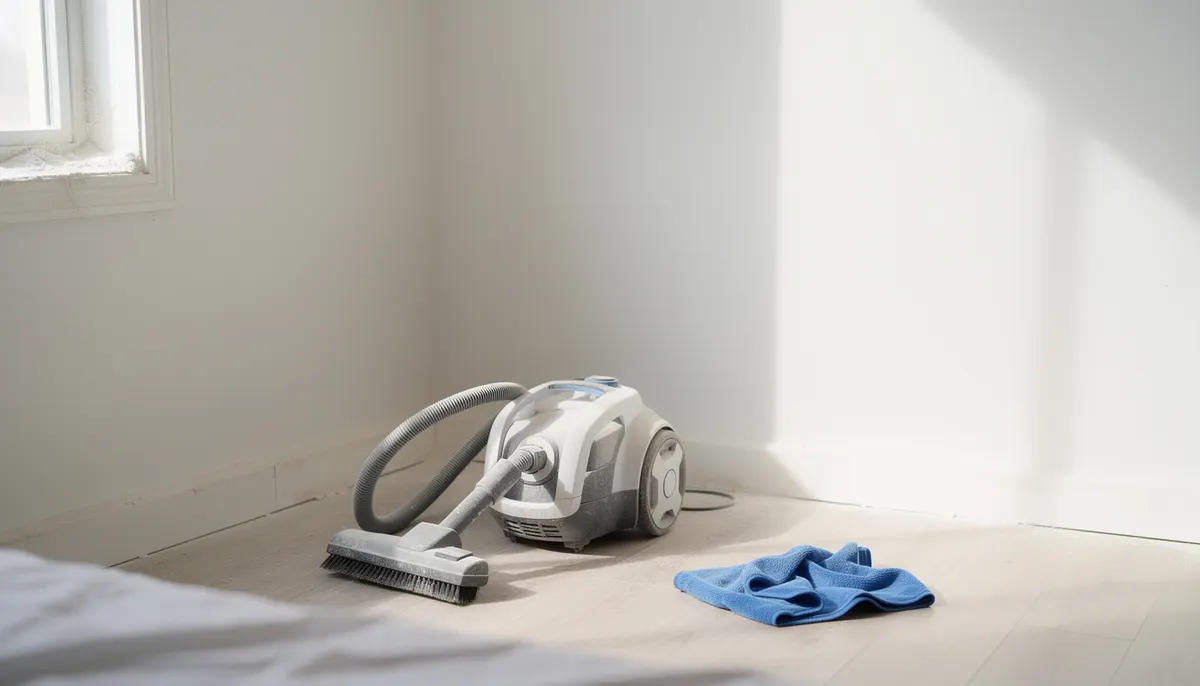
Why drywall dust keeps coming back
Most people who ask me how to clean drywall dust have already cleaned it twice. It comes back because the finest particles were still floating when the first wipe-down happened, and they kept landing on freshly cleaned surfaces for hours afterward. That is not a cleaning failure, it is physics, and you can work with it once you know the timeline.
Drywall joint compound is a blend of gypsum, talc, calcite, mica, and in some products silica, and sanding it produces dust across a huge range of sizes. The big flakes drop in under a minute. The tiny ones behave more like smoke.
| Particle size | How long it stays airborne in still air |
|---|---|
| 15 to 100 microns | Under a minute |
| Under 10 microns | About 3 minutes |
| Around 5 microns | About 8 minutes |
| Around 1 micron | 4 hours or more |
Two things make it worse in a lived-in house. Every footstep, door swing, and furnace cycle kicks settled dust back up, and dry dusting adds static that flings it into the air instead of capturing it. So the job is less about scrubbing harder and more about sequencing.
Let it settle before you touch anything
Wait at least overnight after the last sanding before you start cleaning in earnest. The 1 micron particles need four hours or more in perfectly still air, and a house with people in it is never still. I tell homeowners to close the doors to the renovated area, switch the furnace fan from “on” to “auto” so it is not circulating air for no reason, and come back the next morning.
Resist the urge to open windows and run box fans to clear it out the same day. Moving air keeps the fine particles suspended longer and carries them into rooms that were never part of the renovation. Ventilation matters, but it matters after the heavy vacuuming, not before.
If the drywall work finished a week ago and your contractor has already done a broom-level sweep, you are past this step. Move on to the vacuum.
Which vacuum should you use for drywall dust?
Use a vacuum with a HEPA-rated filter, or a shop vacuum fitted with a fine-dust collection bag and a HEPA cartridge. A HEPA filter captures at least 99.97 percent of particles at 0.3 microns, which is the size range a standard household vacuum filter lets straight through and blows back into the room.
Your everyday upright is the wrong tool here, and not only because it exhausts fine dust. Gypsum dust works into the motor bearings, mixes with the lubricant, and turns it into an abrasive paste. I have watched more than one good vacuum die the week after a basement finish.
| Vacuum type | Captures fine gypsum dust? | Risk to the machine | Verdict for drywall dust |
|---|---|---|---|
| Household upright or canister, standard filter | Poorly, much is exhausted back out | High, motor and filter damage | Avoid |
| Shop vacuum, bagless with standard cartridge | Partly, filter clogs fast | Moderate, suction drops and motor runs hot | Only for a quick first pass |
| Shop vacuum with fine-dust bag and HEPA cartridge | Yes | Low | Good, most practical for DIY |
| HEPA-rated vacuum with brush attachments | Yes | Low | Best for walls, ledges, and trim |
Go slowly. Fast passes push dust ahead of the nozzle instead of pulling it in. Use the soft brush attachment on walls, ceilings, and trim, and empty the canister or bag outdoors so you do not undo the work in the doorway.
Damp microfibre, not a dry duster
A dry cloth or feather duster moves drywall dust around; a damp microfibre cloth removes it. The moisture kills the static, weights the particles, and traps them in the fibres so they leave the house with the cloth instead of resettling an hour later.
Wring the cloth until it is barely damp. A wet cloth turns gypsum into a thin paste that streaks across paint and dries as a haze, which is the mistake I see most often on freshly finished walls. Fold the cloth into quarters, wipe in one direction, flip to a clean face, and rinse in a bucket of plain water every few passes.
The cloth matters as much as the vacuum when you are working out how to clean drywall dust off painted walls. Plain water is enough for the first round; keep the cleaning products for fixtures and glass at the end. On new paint, wipe lightly and ask your painter before scrubbing anything that is only a few days old, since latex paint keeps curing for weeks after it feels dry.
How to clean drywall dust in the right order
Work top down and finish with floors, every single time. Anything you knock loose from above lands on what you already cleaned below, so this sequence saves you from doing the floor three times.
- Ceiling fixtures, fan blades, and the top edges of door and window casings
- Tops of cabinets, shelves, and the upper walls (vacuum with the brush first, then damp wipe)
- Lower walls, window frames, tracks, and sills
- Cabinet and closet interiors, including shelf-pin holes and drawer boxes
- Countertops, fixtures, and switch plates
- Baseboards and the floor edge where dust piles up
- Floors: vacuum slowly, then damp-mop with clean water, rinsing the mop head every few square metres
Expect the first mop bucket to turn grey almost immediately. Change the water as soon as it clouds, otherwise you are painting the floor with gypsum. On unsealed grout or hardwood, keep the mop nearly dry.
Do the rooms that were not renovated too. Dust travels through door gaps and the return-air system, and the bedrooms upstairs usually carry a lighter film that shows up on dark furniture and screens a few days later.
Furnace filter and vents: the step everyone skips
Replace the furnace filter as soon as the renovation is over, and check it again two weeks later. During heavy dust-producing work, 3M’s Filtrete guidance is to change the filter as often as weekly on big projects, and general guidance is to inspect it every couple of weeks while construction dust is in the air. A clogged filter drops airflow, and a filter loaded with gypsum for a month keeps shedding it every cycle.
Then deal with the covers. Pull the floor registers and wash them in the sink, and vacuum the return-air grilles with the brush attachment, because those grilles are the most concentrated dust traps in the house. The ducts themselves are an HVAC contractor’s territory, not a cleaning crew’s, so if the system was open during the reno, ask your contractor whether the runs were sealed off.
Ontario timing makes this step matter more. A renovation that wraps up in October or later means the windows stay shut and the furnace runs for the next five months, recirculating whatever is left in the system.
Plan a second pass about a week later
The first clean removes most of the dust; the second clean, roughly a week out, removes what the first one stirred up. Fine particles that settled inside light fixtures, on top of trim, and in the ductwork keep drifting down as the house gets used, and a light film returns on horizontal surfaces even after a thorough job.
Knowing how to clean drywall dust is mostly knowing that it takes two rounds. The second pass is quick compared with the first:
- Damp-wipe horizontal surfaces: sills, shelves, counters, the tops of baseboards
- Vacuum floors with the brush head, especially along walls and under radiators
- Wipe screens, dark furniture, and glass, where the film shows first
- Check the furnace filter and swap it if it has greyed
If dust is still returning after the second pass, look for the source rather than cleaning a third time. The usual culprits are an unfinished area behind a door, a return grille that was never wiped, or cabinet tops nobody reached.
When this is worth handing off
A single room is a manageable weekend. A whole-floor or whole-home renovation is a different scale: every wall, every cabinet interior, and every square metre of floor, twice. Our post-renovation detail cleaning covers exactly this sequence, from vent covers and ledges down to the final damp mop, once your contractor has removed all debris, materials, and packaging from the site.
It is a different scope from a standard deep clean, and the difference between deep and regular cleaning is a useful frame: drywall dust needs a reset, not maintenance. Tell us what was renovated and when the trades finish, and we will quote the detail clean around the real completion date rather than the one on the original schedule.
Tonight, pull the furnace filter and look at it. If it is grey, you have your first task, and your second pass is already on the calendar.