
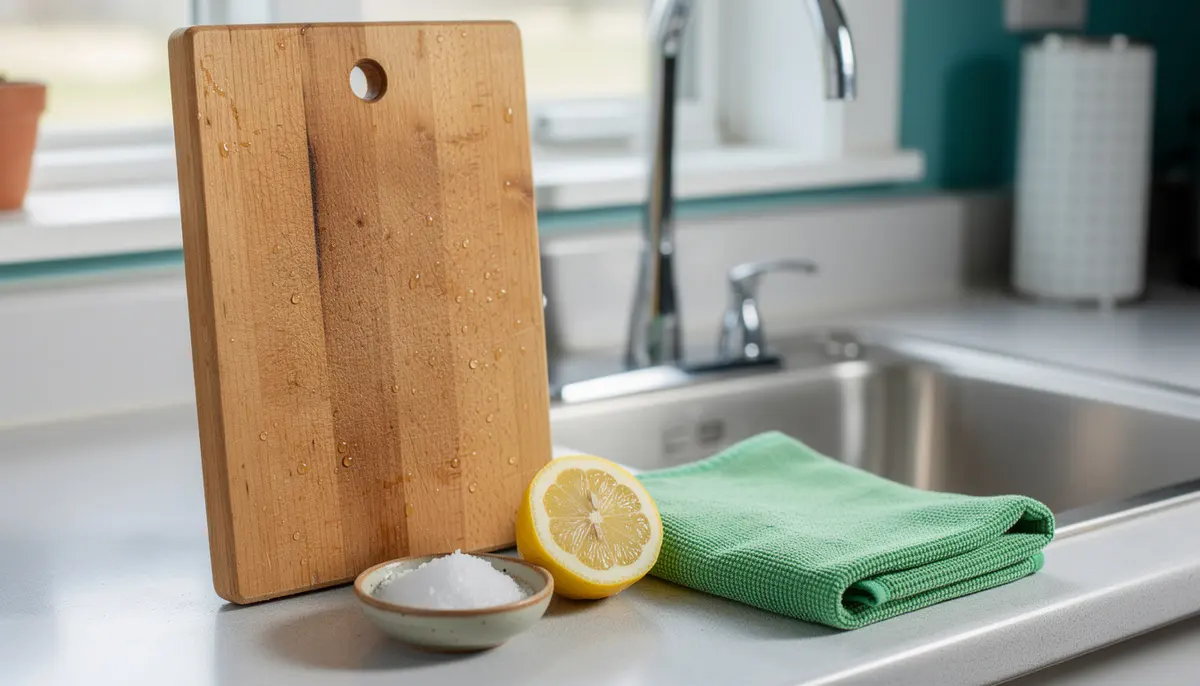
How to clean a wooden cutting board daily: two minutes, no special products
Most of what you need to know about how to clean a wooden cutting board fits in one sentence: wash it with hot water and dish soap right after you use it, dry it with a towel, and stand it on edge. That is the entire daily routine. No soaking, no dishwasher, no spray from the cleaning aisle.
I have handled a lot of cutting boards in a lot of Durham Region kitchens, and the ones that look terrible are almost never the old ones. They are the ones that got left in the sink, or lay flat and wet on the counter overnight.
Age is fine for wood. Standing water is not.
Here is the routine that keeps a board flat and clean for years:
- Scrape food scraps off with a bench scraper or the back of a knife.
- Wash both faces and all four edges with hot water and a few drops of dish soap, using a sponge or soft brush. Washing only the top face wets one side more than the other, and the board cups as it dries.
- Rinse quickly under the tap. Do not let it sit in the water.
- Wipe it dry with a clean towel, then stand it on edge or in a rack so air reaches both faces.
Total time is about two minutes. The board should be dry to the touch within an hour.
When does a wooden cutting board actually need sanitizing?
Sanitize after raw meat, poultry, or seafood, and any time the board has been sitting damp long enough to smell. Soap and water remove food and most bacteria; a sanitizer kills what soap leaves behind. A board that only ever sees bread, cheese, and vegetables does fine with a weekly sanitize.
The boards that worry me are the ones used for chicken, rinsed under the tap, and then used for the salad. A rinse is not a wash, and a wash is not a sanitize. Those are three separate steps, and skipping the third one after raw meat is the single most common cutting board mistake I see.
Both Health Canada and the USDA accept wood for raw meat provided you sanitize it afterward. The USDA also suggests keeping one board for produce and bread and a separate one for raw meat, poultry, and seafood. A second board costs less than a night of food poisoning.
Which sanitizer works on wood?
Diluted household bleach is the sanitizer both Canadian and American food safety agencies name for cutting boards. Undiluted white vinegar or 3 percent hydrogen peroxide also work for lighter duty. Most advice on how to clean a wooden cutting board stops at soap; this is the step that actually deals with raw chicken.
| Sanitizer | Mix | How to apply | Notes |
|---|---|---|---|
| Bleach (Health Canada ratio) | 5 mL (1 tsp) unscented bleach in 750 mL (3 cups) water | Flood the surface, stand a few minutes, rinse, air dry | Mix fresh each time; diluted bleach loses strength |
| Bleach (USDA ratio) | 1 tbsp unscented bleach in 3.8 L (1 gallon) water | Flood the surface, stand several minutes, rinse, air dry | Slightly weaker mix, same method |
| White vinegar (5 percent) | Undiluted | Spray or pour, let sit, wipe | Fine for produce boards, milder than bleach |
| Hydrogen peroxide (3 percent) | Undiluted | Pour on, let sit several minutes, rinse | No lingering smell |
Health Canada’s mix is a touch stronger than the USDA’s. Either one does the job on a board that has already been washed, and neither should ever be combined with vinegar or any other cleaner. Sanitizer applied over food residue mostly sanitizes the residue, which is why the wash always comes first.
After the contact time, rinse the board with clean water, towel it, and stand it on edge again. Bleach smell on a wood board means it was not rinsed enough, not that it is somehow cleaner.
How to oil a wooden cutting board (and how often)
Oil a board about once a month with food-grade mineral oil, or a mineral oil and beeswax conditioner, and sooner if water stops beading on the surface. Oil fills the wood pores so juices sit on top instead of soaking in. A dry board drinks liquid, stains, and eventually cracks.
The test is simple. Drip a little water on the clean, dry board. If it beads, you are fine; if it darkens and soaks in within a few seconds, oil it that night.
- Start with a clean, fully dry board.
- Pour a generous puddle of food-grade mineral oil on the surface. You want more than feels reasonable; the wood will take it.
- Rub it in with a clean cloth or paper towel, covering both faces and all edges.
- Leave it several hours or overnight, standing on edge or on a rack.
- Wipe off whatever has not absorbed.
Skip olive, canola, and other cooking oils. They never fully cure, so they turn tacky, then rancid, and the board starts to smell like an old fryer. Mineral oil is sold in the pharmacy aisle as a laxative for a couple of dollars, and food-grade board oil is the same thing in a nicer bottle.
Five habits that ruin a good board
Every warped or split board I have come across traces back to one of these. None of them is a knife problem.
- Running it through the dishwasher. Solid wood may survive a cycle or two; glued and inlaid boards split at the joints. The heat and the long soak both work against the wood.
- Soaking it in the sink. Same damage, slower. Ten minutes of standing water is enough to lift the grain.
- Drying it flat on the counter. The bottom face stays wet while the top dries, and the board cups. Always dry on edge.
- Conditioning it with cooking oil. See above. Sticky, then rancid.
- Ignoring deep grooves. Once knife cuts get deep enough to trap food you cannot scrub out, the board needs sanding or replacing. A sheet of medium sandpaper and ten minutes brings most boards back.
Is wood safer than plastic for raw meat?
Neither material is unsafe if you wash and sanitize it, and the USDA accepts both for raw meat and poultry. Plastic is nonporous, so it is easier to clean and it can go in the dishwasher. Wood needs hand washing but is gentler on knives and, when sanded, effectively gets a new surface.
The practical answer for most households is a wood board for daily prep and one dedicated plastic board for raw meat. Plastic gets scarred just as quickly as wood, so replace it once the surface is heavily grooved, since deep cuts in plastic cannot be sanded out the way wood can.
Where the board fits in the rest of the kitchen
A cutting board is the one kitchen surface that touches every meal, which is why it gets its own routine instead of being folded into the general counter wipe on a daily cleaning checklist. The counters, sink, and stovetop around it are what a recurring house cleaning visit keeps up with between your own cooking sessions.
When the whole kitchen has drifted past a wipe-down, with grease on the backsplash and cabinet faces and buildup around the sink, a professional deep clean resets those surfaces in one visit. The board still stays with you, though. Nobody else should be oiling it.
Tonight, before you turn off the kitchen light, wash the board, stand it on edge, and do the water-drop test. If the drop soaks in, add mineral oil to this week’s shopping list and give the board an overnight coat this weekend.